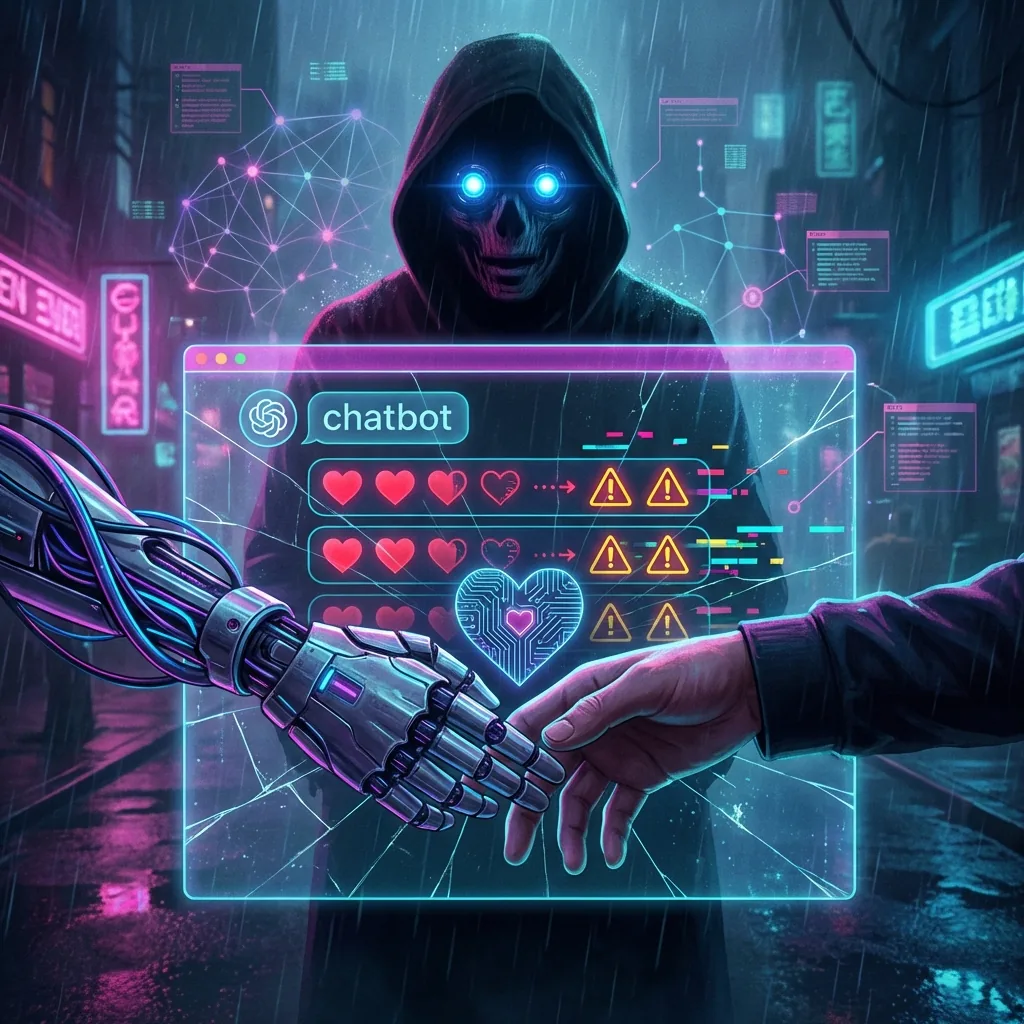
The online dating threat landscape has permanently shifted as transnational fraud syndicates weaponize generative neural networks to execute ai love scams at industrial scale. Where traditional catfishing required an individual operator to manually steal photographs and type persuasive messages for months, modern cybercriminals deploy automated language models, photorealistic diffusion portraits, and real-time voice synthesis to groom dozens of targets simultaneously.
At CLUE, our digital forensics unit has documented a dramatic surge in cases where cautious professionals were deceived by responsive, emotionally attuned synthetic personas. According to consumer warnings published by the Federal Trade Commission (FTC), romance fraud losses exceed a billion dollars annually, with generative media erasing the traditional visual and auditory safety checks that online daters once relied upon.
How AI Love Scams Work Behind the Scenes
To defend your finances and emotional well-being, it helps to understand the technical architecture powering modern ai love scams. Criminal networks operate as structured software enterprises combining four distinct layers of synthetic media:
1. Diffusion-Generated Identity Portfolios
Using fine-tuned Stable Diffusion, Flux, and Midjourney pipelines with character-consistency weights, operators generate hundreds of photos of the exact same non-existent human across diverse settings—at a hospital desk, hiking in the Alps, or cooking dinner. Because these pixels were synthesized from mathematical noise, standard reverse image searches return zero matches.
2. Large Language Model (LLM) Grooming Agents
Uncensored language models fine-tuned on psychological persuasion scripts manage the initial weeks of courtship. Integrated into WhatsApp, Telegram, and dating app APIs, these conversational agents remember every detail you share—crafting empathetic, poetic replies in flawless English around the clock.
3. Real-Time Deepfake Video Puppeteering
When a target becomes skeptical and demands a video chat, the conversation is escalated from the automated chatbot to a human "closer." Using live neural face-replacement software, the operator maps the synthetic profile's face onto their own facial movements at 30 frames per second.
4. Neural Voice Cloning & Emotional Inflection
Paired with live video or used for late-night phone calls, low-latency voice conversion models transform the operator's speech into a warm, native-speaking voice, complete with natural breaths, laughter, and emotional vulnerability.

"I video chatted with him every Sunday for four months. When I hired CLUE for a pre-engagement check, their forensic analysts proved his face was a synthetic model and his audio stream had a 1.8-second processing buffer for real-time voice conversion."
6 Forensic Red Flags of Synthetic Romance Fraud
While generative tools are convincing at a casual glance, they leave measurable behavioral and visual anomalies. Alongside the classic behavioral indicators covered in our guide to romance scam signs, watch closely for these six technical red flags:
1. Hyper-Mirrored Empathy and Zero Friction
Human beings have bad days, strong opinions, and occasional misunderstandings. LLM-driven romance bots are programmed for maximum agreeableness, validating every opinion you express and producing lengthy, grammatically pristine paragraphs within seconds.
2. Circadian Rhythm Anomalies
Automated chat queues do not sleep. If a partner claiming to be a busy surgeon in Zurich responds within 45 seconds at 3:15 AM local time every single day, you are interacting with an automated pipeline or a shift-based call center.
3. Structural Background and Anatomy Hallucinations
Inspect the periphery of their photos. Diffusion models frequently struggle with asymmetrical earrings, distorted text on street signs or coffee mugs, collar seams that vanish into skin, or architectural lines that bend unnaturally.
4. Occlusion Failure and Edge Flicker on Video
Real-time face-swapping networks rely on a facial landmark mesh. When an object passes between the camera and the face—such as a hand scratching the nose or drinking from a glass—the virtual face warps, jitters, or blurs along the jawline.
5. Latency Spikes and Monotone Cadence
Live voice conversion requires encoding acoustic tokens and rendering the target voice. This introduces an unnatural 1-to-3-second pause before every reply and sometimes produces metallic artifacts when background noise interferes.
6. Total Absence of Multi-Year Digital Footprints
A real 42-year-old executive leaves decades of digital exhaust: alumni newsletters, property records, and tagged family photos from years ago. Synthetic personas exist in a historical vacuum with recently created social accounts.
Deepfakes & Voice Cloning: Anatomy of the Deception
The most dangerous aspect of modern ai love scams is how effectively they neutralize human skepticism. According to synthetic media research documented by the National Institute of Standards and Technology (NIST), modern face-reenactment algorithms separate identity features from pose and expression. During a live call:
- Target Encoding: The scammer feeds 30 high-resolution angles of a stolen or AI-generated face into a neural network.
- Driver Capture: A human operator sits before a webcam under controlled studio lighting, matching the head angle of the target model.
- Virtual Camera Injection: Software renders the composite video stream into a virtual webcam driver, broadcasting the synthetic feed over WhatsApp or Zoom.
- Pre-Scripted Cutoff: To prevent you from noticing lip-sync drift, the scammer stages an urgent interruption—a bad cellular connection or a sudden work emergency—ending the call after 60 seconds.
Active Liveness & Chatbot Detection Protocols
If you want to verify identity online when you suspect a synthetic persona or chatbot, introduce physical and cognitive challenges that break automated models:
The 90-Degree Profile & Hand-Wave Test
During a live video call, ask your partner to turn their head completely sideways into a full side profile and slowly wave their open hand directly across their nose and mouth. Real-time deepfake models fail during full side profiles or hand-over-face occlusion, causing the artificial mask to smear visibly.
Dynamic Lighting & Crumpled-Paper Challenge
Ask them to hold a crumpled piece of paper with a random word you just chose written in ink, and move a phone flashlight across their face. Real skin casts consistent directional shadows; neural overlays maintain flat lighting.
False-Memory Trap Questions
Casually reference a fabricated shared memory: "Did your sister ever recover from that skiing accident in Vermont?" A real human will immediately correct you, whereas an improperly prompted romance bot will frequently hallucinate an update on her recovery.
Human vs Synthetic Persona Comparison Matrix
| Telemetry Vector | Authentic Human Partner | AI / Syndicate Persona |
|---|---|---|
| Message Cadence | Irregular; reflects work hours, sleep, and errands | 24/7 availability or rigid multi-paragraph blocks |
| Visual Metadata | Consistent mobile camera sensors, natural skin texture | Stripped EXIF headers, smoothed pores, warped backgrounds |
| Video Geometry | Handles side profiles, glasses reflections, and movement | Locked front-facing posture, edge flicker near hairline |
| Financial Posture | Maintains independent banking; never mixes romance with crypto | Pivots to "exclusive" trading platforms or urgent crises |
Defensive Protocols & Financial Protection
The endgame of all ai love scams is financial extraction—either through fabricated emergencies or cryptocurrency investment schemes. Protecting yourself requires strict adherence to zero-trust verification boundaries:
- Never transfer money, gift cards, wire payments, or cryptocurrency to anyone you have not met face-to-face in the physical world.
- Never install remote-access software or register on an unfamiliar crypto trading app recommended by an online match.
- Immediately preserve all unedited chat exports, profile screenshots, and transaction hashes before the individual deletes their account.
- Consult an independent digital forensics specialist to discreetly verify digital identities, analyze deepfake indicators, and map fund destinations.
When to Engage Professional Forensic Verification
Consumer-grade "AI detectors" on free websites have high error rates once images are compressed by social platforms. When your emotional future or savings are on the line, our romance scam investigation and digital forensics specialists provide definitive clarity:
- Frequency-Domain & Diffusion Forensics: Examining pixel noise residuals and optical lighting vectors to prove whether media was synthesized.
- Primary-Source Identity Verification: Cross-referencing claimed identities against restricted investigative databases and civil registries.
- Telecommunications Attribution: Tracing VOIP carrier allocations and domain registrations linked to fraudulent portals.
Frequently Asked Questions About AI Love Scams
Can scammers really fake a live video call using artificial intelligence?
Yes. Criminal syndicates use real-time face-swapping neural networks and virtual camera drivers to project a stolen or synthetic face over a live human operator during WhatsApp, FaceTime, or Zoom calls.
Why do reverse image searches fail to detect AI-generated dating photos?
Reverse image search engines look for visual matches already indexed on the web. Diffusion models generate brand-new pixel arrangements from noise, meaning the face does not belong to any real person and has no prior web footprint.
How much audio does a scammer need to clone someone's voice?
Modern zero-shot voice synthesis engines require as little as 3 to 15 seconds of clean audio scraped from social media reels or voicemail greetings to replicate cadence, timbre, and emotional inflection in real time.
How do private investigators prove a romantic partner is an AI persona?
Forensic investigators examine frequency-domain artifacts in images, analyze facial landmark jitter in video recordings, inspect telecommunications routing metadata, and trace civil identity records to confirm whether a legal person exists.