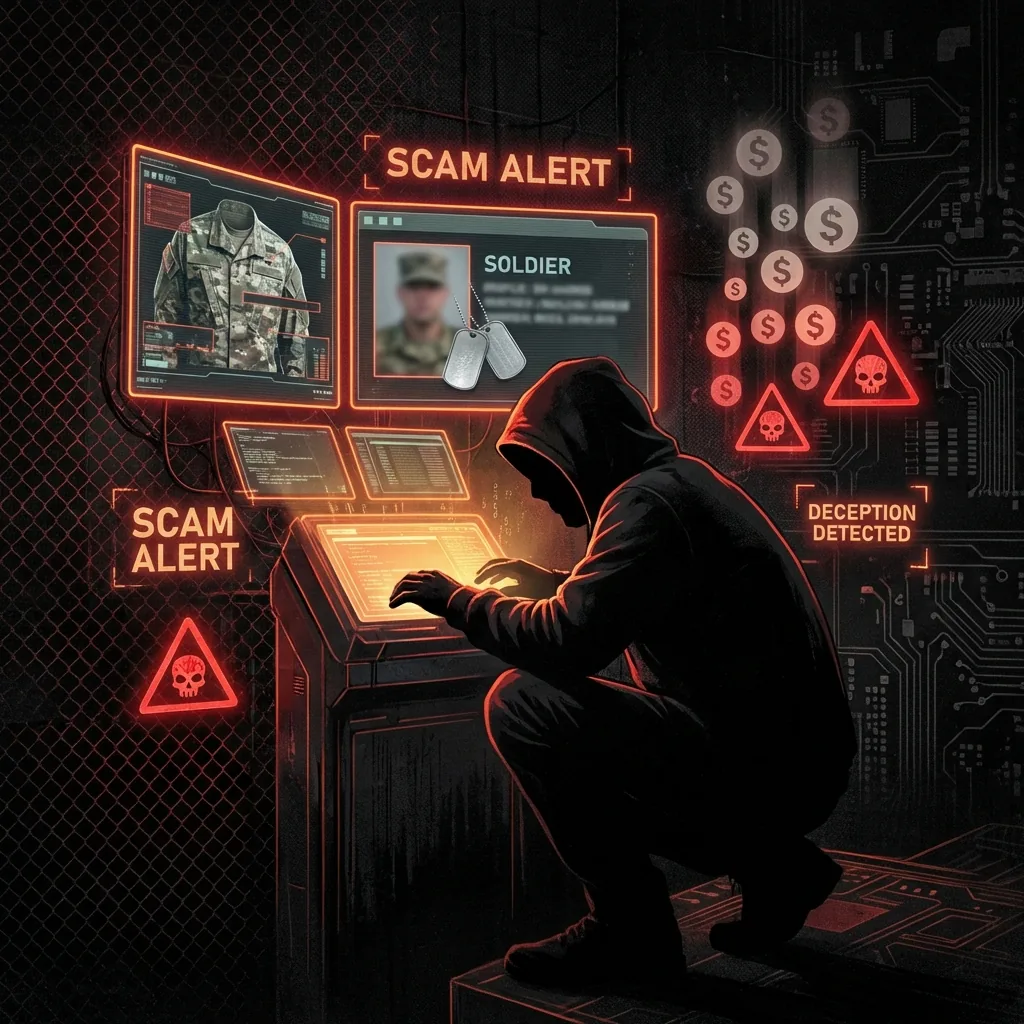
Among all forms of online relationship fraud, military romance scams are uniquely manipulative because they weaponize patriotism, institutional honor, and public respect for the armed forces. Across dating apps, Facebook, Instagram, and Words With Friends, organized criminal syndicates harvest thousands of photographs of real soldiers, sailors, airmen, and Marines to build fraudulent profiles designed to extract life savings from trusting civilians.
At CLUE, our investigative team handles hundreds of military impersonation inquiries each year. Often, the real service member whose photographs were stolen has no idea their uniform and family photos are being used by overseas call centers to defraud targets across North America and Europe. Understanding how these impostors operate—and how real military procedures work—is your strongest defense against financial and emotional harm.
Why Scammers Pose as Deployed Military Personnel
Criminal syndicates deliberately choose military personas because the operational nature of armed service provides plausible cover for nearly every classic romance scam warning sign:
1. Built-In "Classified Security" Excuses
When a civilian asks a fake soldier for a live video call or specific details about their location, the scammer invokes Operational Security (OPSEC). Phrases like "I'm on a classified peacekeeping mission in Syria" or "The Pentagon prohibits cameras on our forward operating base" silence skeptical questions immediately.
2. Instant Moral Authority and Sympathy
A uniform commands immediate respect. Scammers frequently portray themselves as widowed senior non-commissioned officers or decorated captains raising a young child alone while serving their country—creating an intense emotional obligation to "support a hero."
3. Manufactured Combat Urgency
Impostors exploit the perceived danger of deployment zones to manufacture high-stakes time pressure. Claiming they are about to be sent on a dangerous convoy unless emergency leave papers are paid within 24 hours forces victims into panic-driven wire transfers.
Common Scripts Used in Military Romance Scams
While individual details vary, our forensic analysts see the exact same four financial extraction scripts repeated across 95% of military romance scams:
1. The "Fiancée Leave Request" & Replacement Fee
The impostor claims they want to fly home to marry you, but their commanding officer requires you to email a "Leave Processing Department" (always a free Gmail or Outlook address) and pay $1,500 to $8,000 for "leave insurance," administrative filing fees, or to hire a replacement soldier.
Forensic Fact: Leave is an earned military benefit; service members never pay to take leave, and civilians cannot request it for them.
2. The Communication Permit & Gift Card Demand
The scammer claims their base internet bandwidth is expiring or they need Apple, Steam, or Razer Gold gift cards—or Bitcoin—to renew their "secure satellite phone license" so they can keep talking to you.
Forensic Fact: The armed forces provide Morale, Welfare, and Recreation (MWR) communication centers; gaming gift cards cannot buy military bandwidth.
3. Combat Injury & Medical Evacuation Fees
Either the soldier or a person posing as an army doctor contacts you urgently, claiming the soldier was wounded in an ambush and requires immediate wire transfers to cover surgical supplies or a medical flight to Germany.
Forensic Fact: The Department of Defense provides 100% comprehensive combat medical care and aeromedical evacuation at zero cost to troops.
4. The Captured Portfolio or Consignment Box
The soldier claims to have been awarded a peacekeeping bonus or discovered gold bars overseas and needs to ship a "diplomatic portfolio box" to your home address for safekeeping—followed by fake customs agents demanding thousands in clearance fees.
Forensic Fact: This is an advance-fee fraud script; no such consignment trunk exists.

7 Red Flags of a Fake Soldier Online
You do not need prior military service to spot an impostor. Watch closely for these seven inconsistencies that expose military romance scams:
- Forged Military ID Cards (CAC): Under US federal law, photocopying or photographing an official Department of Defense Common Access Card (CAC) is strictly prohibited. If someone sends you a photo of their "military ID" unsolicited to prove they are real, it is a Photoshop forgery.
- Inaccurate Deployment Locations: Scammers routinely claim to be active-duty US soldiers deployed on "United Nations peacekeeping missions" in Yemen, Syria, or Nigeria. Official advisories from Military OneSource confirm that US forces do not operate solitary peacekeeping camps where troops are stranded without banking access.
- Mismatched Uniforms, Ranks, and MOS Codes: Impostors frequently claim to be a "Four-Star General" or "Special Forces Captain" on a public dating app, or their uniform collar insignia and name tapes do not match their claimed branch.
- Private Civilian Email Addresses for Official Business: Official military correspondence always uses a `.mil` domain. A "commanding officer" or "leave board" will never email you from `@gmail.com` or `@usa.com`.
- Frozen Bank Account Claims: Active-duty service members receive direct deposit pay twice a month and maintain uninterrupted access to their accounts worldwide.
- Requests to Receive or Forward Packages: Asking you to receive checks or wire transfers and forward them to an overseas address or crypto wallet turns unsuspecting victims into unwitting money mules.
- Syntax and Cultural Discrepancies: Many operators behind fake US soldier profiles work out of overseas cybercrime compounds and use awkward phrasing such as "Am a military man on peacekeeping mission."
How Real Armed Forces Operations Compare to Scam Myths
According to consumer protection briefings from the Federal Trade Commission (FTC), scammers rely on civilians not knowing how military logistics operate:
| Topic | Official Military Reality | Scammer Fabrication |
|---|---|---|
| Leave & Vacation | Free; requested internally by the soldier via digital chain of command | Costs thousands; requires fiancée application and replacement fee |
| Transportation Home | The military flies deployed troops back to their home station at government expense | Claims to be stranded overseas needing commercial airfare money |
| Food, Housing & Medical | 100% provided on deployment; full combat medical coverage | Claims to be starving on base or needing wire transfers for surgery |
| Video & Phone Access | Allowed in non-classified living quarters and MWR centers | Claims total ban on video calls while texting 6 hours daily on WhatsApp |
How to Verify Military Service Claims Step by Step
If you are communicating with someone who claims to be in the armed forces, use these structured protocols to verify identity online before investing deeper trust:
Demand an Official .mil Email Verification
Ask the individual to send a brief email from their official `.mil` email address—not a screenshot of one, and not from a third-party domain.
Reverse Image Search Uniform Photos
Run every uniform and casual photo through Google Lens, TinEye, and Yandex to uncover stolen Instagram galleries.
Test Specific Military Knowledge
Ask conversational questions every real service member knows instantly: "Where did you attend Basic Training or AIT, and what is your exact MOS/AFSC code?"
Verify Through Official APO/FPO Postal Standards
Every deployed US service member has an official Military Postal Service address formatted with an APO or FPO designation—never a civilian address in Ghana, Turkey, or Nigeria.
What Real Military Personnel Will Never Do
- Ask an online romantic acquaintance for wire transfers, gift cards, cash apps, or cryptocurrency.
- Have a "commander," "diplomat," or "UN official" contact a civilian regarding fees or leave paperwork.
- Ask a civilian to open a bank account, cash checks, or receive packages on their behalf.
"He told me he was a US Army Major stationed near the Syrian border and sent me a marriage application form with a $3,800 fee. CLUE proved within 24 hours that the photos belonged to a retired Sergeant in North Carolina and the email traced back to West Africa."
Discreet Verification & Professional Investigative Support
If you suspect you are being targeted by military romance scams—or if a family member is sending money to a claimed soldier overseas—early intervention is critical. Our romance scam investigation and background check specialists conduct discreet verifications that provide undeniable proof. If funds have already been transferred, preserve all communication logs and receipts immediately and consult our digital forensics team for a private, confidential case assessment.
Frequently Asked Questions About Military Romance Scams
Do deployed US military personnel ever have to pay for leave or a replacement soldier?
No. Under United States Department of Defense regulations, there is no fee to apply for military leave, no requirement for a fiancée or civilian to request leave on a soldier's behalf, and no such thing as paying for a replacement troop.
Can a deployed soldier video chat or access their bank account overseas?
Yes. Deployed service members have access to Morale, Welfare, and Recreation (MWR) internet facilities, Wi-Fi on established bases, and full online banking through military financial institutions like Navy Federal and USAA.
How can I tell if a military email address is real or forged?
All official US armed forces email addresses end in ".mil" (never ".mil.us", "@usa.com", or "@gmail.com"). Because scammers frequently send screenshots of forged documents, never rely on a screenshot of an ID card or email as proof.
Can a private investigator verify if someone is actually serving in the military?
Yes. Licensed investigators cross-reference the Defense Manpower Data Center (DMDC), public deployment records, unit rosters, and reverse-image OSINT databases to confirm whether a person is an active-duty service member or a stolen identity.